Thomas E. Sorboe
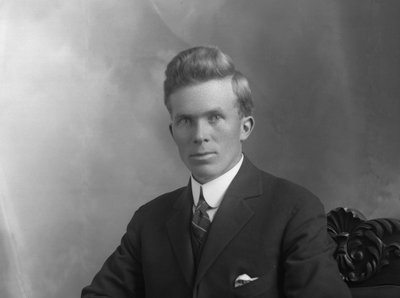
Thomas E. Sorboe
Thomas E. Sorboe was born July 15, 1882, in Norway, and came to Harlowton at an early age — one of the many Scandinavian immigrants who settled the Upper Musselshell Valley in the town's earliest years. He built a career locally as a cabinet maker and building contractor, and over the following decades became one of the town's most active civic figures, serving for many years on the Harlowton town council and belonging to the Odd Fellows Lodge for more than fifty years.
But it was as a photographer that Sorboe left his most lasting mark. In 1908 he opened a photography studio in Harlowton, running it until 1919. He reestablished the studio business in 1943 and continued taking photographs until his retirement in 1956, at age 64. Over those years — and even during the gap in between, when he was working as a builder — Sorboe became, if anything, better known around town for his camera than for his hammer. His negatives capture generations of Harlowton families, made up largely of studio portraits, along with exterior views of the town and the surrounding country reaching out to Lennep and White Sulphur Springs.
The scale of that work only became fully clear after his death. The Sorboe Collection, donated to the Museum of the Rockies in Bozeman in 1975, holds more than 5,340 of his original glass plate and safety film negatives, cataloged and searchable by surname. A number of Sorboe's original prints and photographs can also be seen here at the Upper Musselshell Museum, alongside the rest of the town's visual history.
Thomas Sorboe died January 1, 1971, at Wheatland Memorial Hospital in Harlowton, at the age of 89. Funeral services were held at Perkins Funeral Home, with burial in Harlowton Cemetery and members of the Odd Fellows Lodge taking part in the service. He was survived by a brother, Gus Sorboe, of Altadena, California.
Sources: “Thomas E. Sorboe Collection,” Museum of the Rockies Photo Archive, Montana State University — arc.lib.montana.edu/mor/sorboe; and an obituary published in the Billings Gazette, January 5, 1971.