Albert Silberling
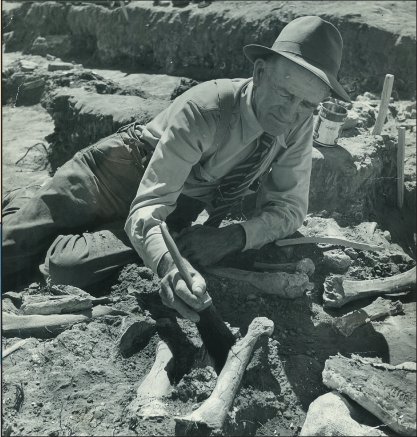
Albert Silberling in the Redrock Mountain area near Harlowton, 1949
Albert Charles Silberling was born on March 13, 1883. As a young man he joined a Princeton University field party led by M. S. Farr, and in 1902 that work brought him to a small exposure of fossil-bearing rock southwest of Harlowton. Alongside Princeton paleontologist Earl Douglass, Silberling discovered the site that would come to be called Douglass Quarry — though his own collecting that first season turned up only a handful of isolated teeth and bone fragments. It was the beginning of a connection to the site that would last the rest of his life.
Around 1919, Albert and his wife, Madge Hattie Cole Silberling, settled with their family in Harlowton. Madge had been previously married to Guy Hartwell Davis, who died in 1912; she and Albert raised her daughter Nellie alongside their own three children, Louise, Robert, and Albert Jr. In Harlowton, Albert found work as a machinist's helper for the Milwaukee Road, at the point along the line where steam and later diesel locomotives were exchanged for electric power for the 438-mile run through the Rocky Mountains to Avery, Idaho.
Despite having no formal scientific training, Silberling kept working the quarries around Harlowton for decades, developing an eye for the region's Paleocene beds that few others could match. In 1936 he reopened a nearby site that became known as Scarritt Quarry. Then, in March 1940, he made his most significant find: several jaws and teeth still in place in the rock at Douglass Quarry. He returned to the site that summer with John A. Bell, then a Princeton undergraduate, for a seven-week excavation, joined briefly by Professor G. L. Jepsen of Princeton and H. Bott of the University of Utah. That season's dig recovered roughly 170 specimens, and the collection became the basis of Bell's senior thesis at Princeton.
Over four decades of work, Douglass Quarry and the other sites Silberling helped uncover yielded the remains of at least 23 species of Paleocene mammals — among them Ptilodus, a squirrel-like multituberculate; Phenacodus, a primitive hoofed mammal; and Plesiadapis, one of the earliest primate relatives known to science. A second nearby locality, Silberling Quarry, was later named in his honor. His discoveries were incorporated into published paleontological research for decades afterward, giving scientists a clearer picture of what life looked like in the millions of years following the extinction of the dinosaurs.
Albert Silberling died on May 3, 1951. Madge had preceded him in death in 1946. Their daughter Louise went on to graduate from Harlowton High School and later trained as a nurse — one of many Harlowton families whose roots trace back to the town's early railroad and homesteading years.
Sources: “Paleocene Mammals and Albert Silberling,” Montana Department of Transportation historical marker; Krause, D.W. and Gingerich, P.D., “Mammalian Fauna from Douglass Quarry, Earliest Tiffanian (Late Paleocene) of the Eastern Crazy Mountain Basin, Montana,” Contributions from the Museum of Paleontology, University of Michigan (1983); and family genealogical records submitted by a descendant. Some biographical details from the family account could not be independently verified and have been presented here with that in mind.